

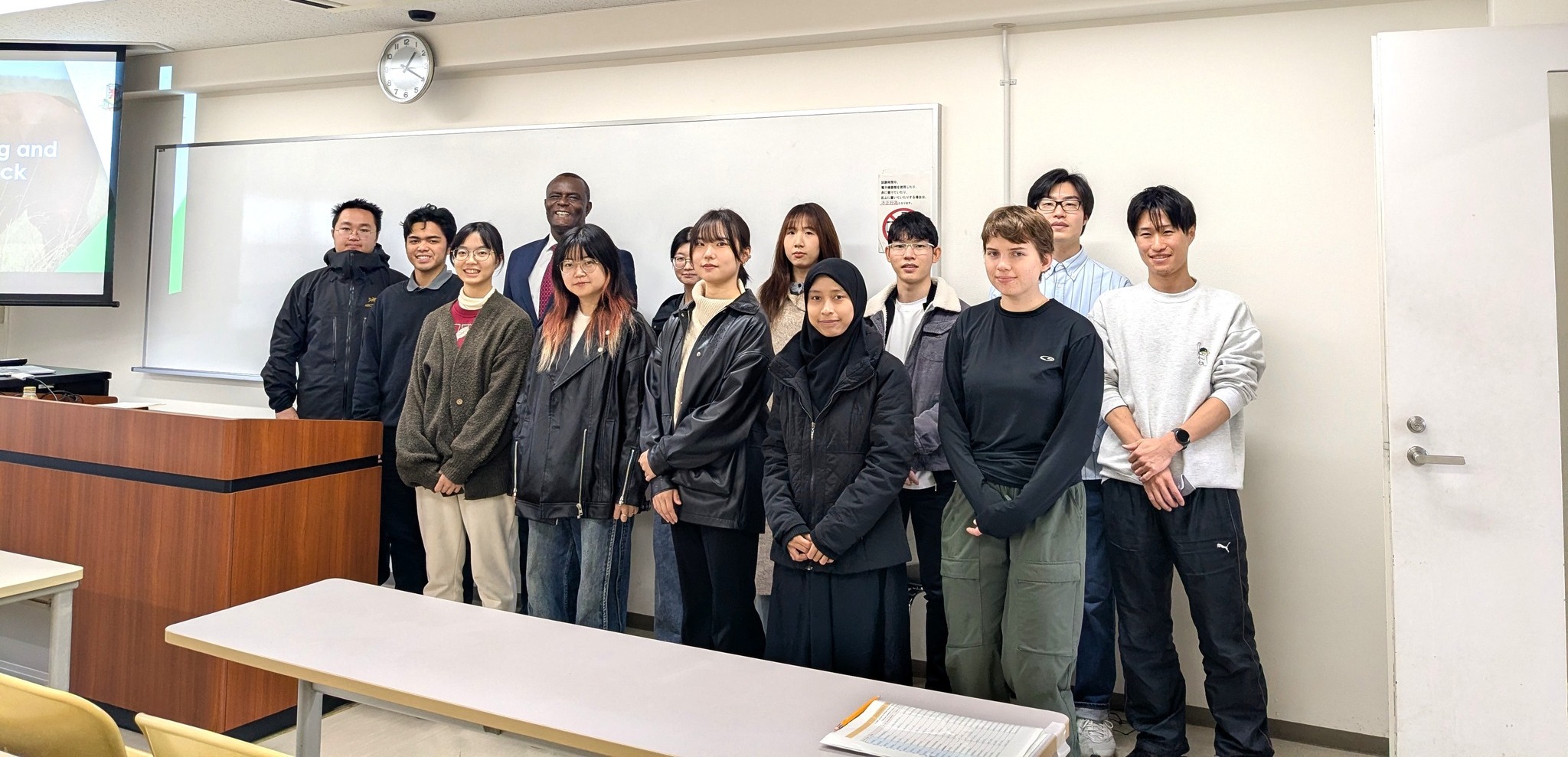
In November 2025, Prof. Alexander K. Kahi of Egerton University delivered a lecture series titled “African Livestock: Avenue for Sustainable Development – A Breeder’s Perspective” at Kyoto University. The course explored livestock production, genetic resources, and future pathways for African systems. More importantly, it highlighted the critical role of cross-learning in advancing sustainable livestock development.
Cross-learning involves the exchange of knowledge across regions, disciplines, and cultures. In African livestock systems, this means blending indigenous knowledge with global scientific practices.
- Livestock production on the continent operates within complex ecological and socio-cultural environments, where solutions must be adapted—not copied—from elsewhere.
- By comparing African systems with those in countries such as Japan, the course demonstrated how global insights can inform local innovation while respecting contextual differences.
A key takeaway was the importance of linking science to real-world conditions. African livestock systems—ranging from pastoralism to mixed crop-livestock farming—are deeply embedded in community life. Cross-learning ensures that advancements in breeding and genetics are applied in ways that align with local livelihoods and cultural practices. Without this integration, even the most advanced technologies risk being ineffective or unsustainable.
The course also emphasised the value of Africa’s rich livestock genetic diversity. Indigenous breeds are often resilient to harsh climates and diseases, making them vital for long-term sustainability. Through cross-learning, global genetic research can support conservation efforts while also learning from Africa’s experience with resilience and adaptation. This mutual exchange strengthens both local and global agricultural systems.
An article published by the Asian Platform for Global Sustainability & Transcultural Studies (AGST) (https://agst.jgp.kyoto-u.ac.jp/wp-content/uploads/2026/04/AGST-newsletter-2026-SpringSummer.pdf) speaks to how the course further strengthened interactive learning. Group discussions and student presentations encouraged participants to engage with diverse perspectives and apply knowledge collaboratively. This approach reflects the broader goals of sustainable development, which require critical thinking, adaptability, and cooperation across disciplines and cultures.
Another important insight was the social and cultural significance of livestock in Africa. Beyond economic value, livestock contributes to identity, tradition, and community cohesion. For students from outside the continent, this perspective broadened their understanding of agriculture as a holistic system. Cross-learning makes such insights possible, fostering respect for different knowledge systems and avoiding purely technical approaches to development.
By connecting global expertise with local realities, it promotes solutions that are both innovative and contextually appropriate. The course by A. K. Kahi illustrates how shared knowledge and collaboration can drive resilience, inclusivity, and long-term sustainability in African livestock development.
Read more: https://agst.jgp.kyoto-u.ac.jp/wp-content/uploads/2026/04/AGST-newsletter-2026-SpringSummer.pdf