

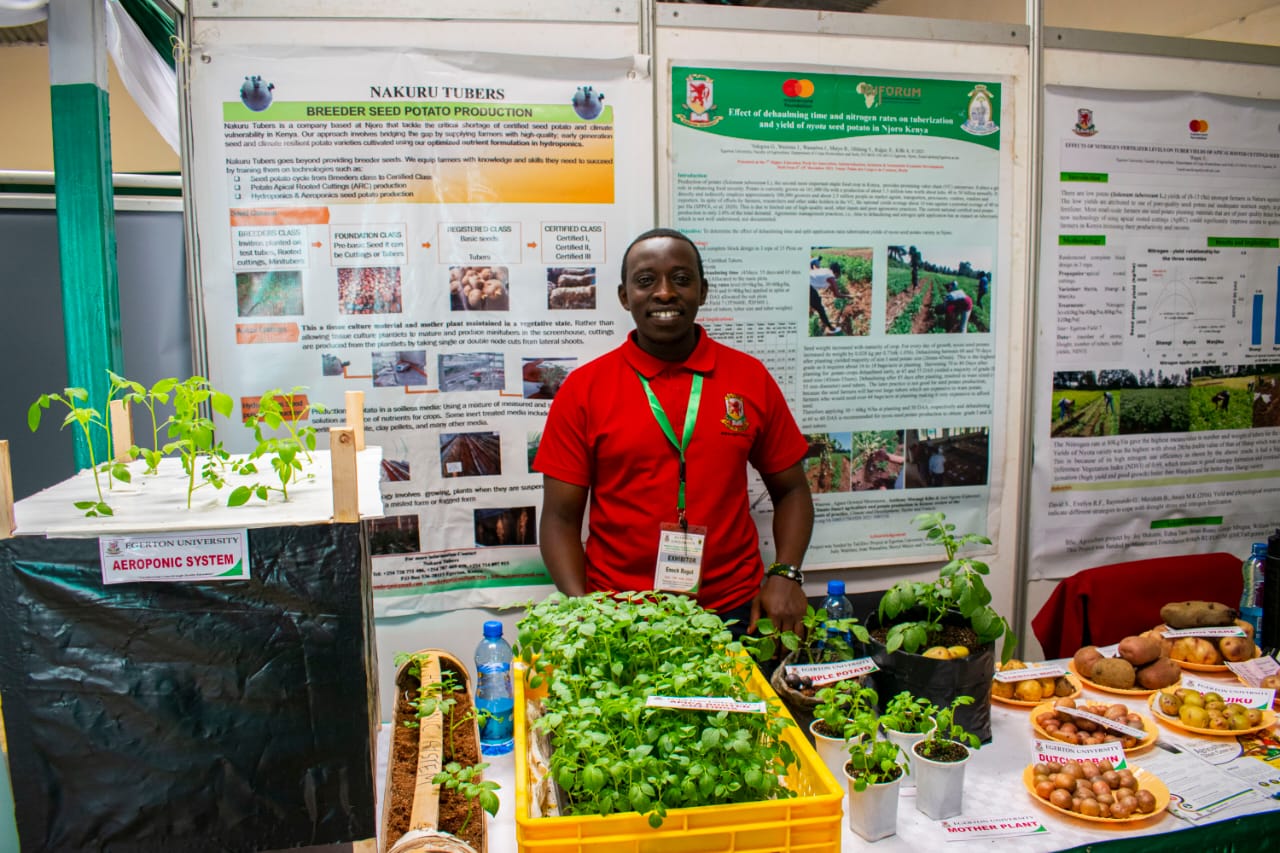
Over three million Kenyans rely on potato farming as a source of employment because potatoes are Kenya's second most important cash crop, attracting around 800,000 farmers. However, productivity is limited due to a lack of quality seeds. Nakuru Tubers, an agricultural start-up based in Kenya, is working to address this challenge with the support of the CoELIB Project. Mr Enock Rugut, Co-Founder and Chief operating officer of Nakuru Tubers, joins us to share their work in the potato sector.
Please introduce yourself and tell us more about your background in agriculture.
Thanks for having me; I am Enock Rugut, the Chief Operating Officer and Co-Founder at Nakuru Tubers. Away from my work with Nakuru Tubers, I am also pursuing a master's in breeding and genetics at Egerton University. My work in the Agriculture sector mainly aims to improve productivity and ensure sustainable practices.
Great! What inspired the foundation of Nakuru Tubers?
Well, the inspiration came from the need to have quality potato seeds; we were also inspired dramatically by climate change and low yields; that said, Nakuru Tubers is a venture focused on Empowering smallholder farmers in Africa; we help them adopt tissue culture and hydroponics, all these in the desire to have quality and disease free seed potatoes.
Since its inception, what has been Nakuru Tuber's most significant achievement?
Good question; we have had so much success, but the biggest, in my opinion, is being able to create an establishment that is commercially relevant and deeply rooted in communities. Daily, we combine scientific inventions with a strong focus on farmer empowerment; sounds easier said than done, right?
Well, congratulations on this achievement. How do you think the agricultural ecosystem has evolved over the years?
Thank you. Since the inception of Nakuru Tubers, the ecosystem has seen farmers in Nakuru and beyond embracing more innovative farming methods. There is access to quality seeds, and notably, we have also seen more climate-smart practices being implemented by farmers. All these combined have led to better yields, increased farmer collaboration, and good cash flow.
It's clear Nakuru Tubers has been working; how can we measure our impact so far?
Good question. To assess our impact, we look at the increase in crop yields over the years, food security and also feedback from farmers we work with; for example, recently, we brought on board Digital Connectors( Youth based on various locations) who are responsible for meeting our clients at the grassroots level to solve their problems, with this we have been able to provide a solution fast and efficiently.
Great, any success stories?
For sure, so many farmers report improvements in their income and yields after using our seeds and putting into practice recommended farming techniques. In Elburgon, for example, we have a number of farmers benefiting from our technical support; their success is our success.
Your website talks of your involvement in climate-smart agriculture. Are there any types of potato seeds that are climate-resilient?
Yes, like I said in the beginning, the desire to be part of the solution to the climate crisis was part of our inspiration. To that end, we have researched a lot on this; we have seeds that are resilient to climate and go along the way to improve soil structure. To see more, you can visit our website.
Please explain the connection between Nakuru Tubers and the CoELIB Project.
Yes, in our bid to transform the potato value Chain in Africa, we collaborate closely with CoELIB.The center supports our seed development work and also provides incubation facilities. Their business incubation support and media support have really helped us grow; thanks to this collaboration, we are able to make an impact in the agricultural sector.
Tell us about the collaborative projects between Nakuru Tubers and CoELIB.
The CoELIB Project plays a significant role in developing our business model. Their expertise in market analysis and business development has been crucial in our day-to-day operations. Over the years, we have collaborated on grand and investment proposals, some of which have helped us secure funding, generally broadening our impact. Thank you for sharing the good job Nakuru Tubers is doing; wishing you and your team the very best. Thank you for the opportunity to share what we are doing as Nakuru Tubers; hopefully, we get to catch up in a few months with more developments; we are grateful for the support we have received from CoELIB.